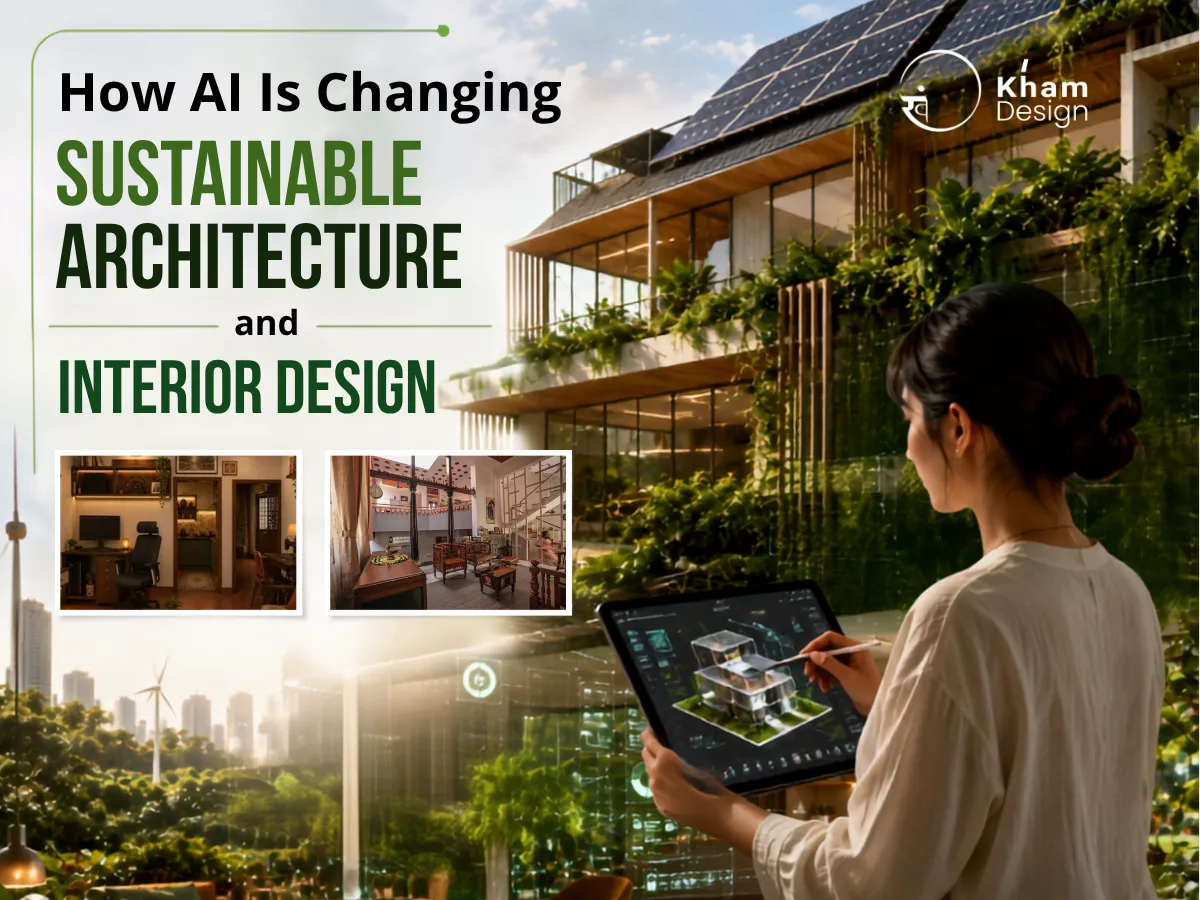
Artificial Intelligence (AI) is rapidly transforming the way buildings are designed, constructed, and experienced. In the world of architecture and interiors, AI is no longer just a futuristic concept—it is now a practical tool that helps create smarter, more efficient, and environmentally responsible spaces.
For an experienced Eco friendly architect, AI is becoming an essential part of the design process. It enables better decision-making, reduces waste, improves energy efficiency, and enhances the overall quality of sustainable living environments.
At Kham Design, we see AI as a powerful design partner that supports human creativity rather than replacing it. When combined with sustainable thinking, AI helps us design homes that are not only visually appealing but also highly efficient and future-ready.
1. AI-Powered Design Optimization for Energy Efficiency
One of the most impactful uses of AI in architecture is energy optimization. Traditional design methods rely heavily on manual calculations and experience, but AI can analyze thousands of design variations in seconds.
This allows Sustainable housing architecture to become more precise and performance-driven.
AI tools can evaluate:
- Sunlight exposure throughout the year
- Wind flow and natural ventilation patterns
- Heat gain and thermal comfort levels
- Energy consumption predictions
- Optimal building orientation
By simulating real-world conditions, AI helps architects design homes that naturally stay cooler, brighter, and more energy-efficient.
This reduces dependency on air conditioning and artificial lighting, directly lowering electricity bills and environmental impact.
2. Generative Design for Smarter Building Layouts
Generative design is one of the most exciting innovations in modern architecture. It uses AI algorithms to generate multiple design options based on specific inputs such as site conditions, budget, materials, and sustainability goals.
For Eco friendly house architects, this means faster and more intelligent decision-making.
AI can suggest:
- Optimal room layouts for natural ventilation
- Efficient space utilization without wastage
- Structural designs that reduce material usage
- Layouts that maximize daylight penetration
- Climate-responsive building forms
Instead of relying on a single design approach, architects can explore hundreds of possibilities and choose the most efficient and sustainable solution.
This leads to more refined Sustainable architecture buildings that are both functional and environmentally responsible.
3. AI in Material Selection and Sustainable Construction
Material selection plays a crucial role in environmentally responsible design. AI is now helping architects choose materials that are not only durable but also energy-efficient and eco-friendly.
In Environmentally friendly architecture, AI tools analyze:
- Carbon footprint of materials
- Thermal performance
- Lifecycle durability
- Cost efficiency over time
- Environmental impact during production
This allows architects to make informed decisions that reduce environmental damage while improving building performance.
For example, AI may recommend low-carbon concrete alternatives, recycled materials, or high-performance insulation based on project requirements.
At Kham Design, we use data-driven insights to ensure every material contributes to long-term sustainability and comfort.
4. Smart Interior Design with AI Assistance
AI is also revolutionizing interior design by making spaces more personalized, functional, and energy-efficient.
Modern smart tools can analyze user behavior and suggest interior layouts that improve comfort and efficiency.
In sustainable interiors, AI helps with:
- Optimal furniture placement for airflow and lighting
- Energy-efficient lighting design
- Smart zoning of living spaces
- Color and material recommendations based on heat absorption
- Space-saving design solutions
This creates interiors that are not only aesthetically pleasing but also aligned with Sustainable housing architecture principles.
AI-driven interiors ensure that every square foot is used efficiently, reducing unnecessary energy consumption and improving daily living comfort.
5. Predictive Energy Modeling for Smarter Homes
One of the most powerful applications of AI in architecture is predictive energy modeling. This technology allows architects to forecast how much energy a building will consume even before construction begins.
An experienced Eco friendly architect can use these insights to refine designs and improve efficiency.
AI can predict:
- Monthly electricity consumption
- Cooling and heating requirements
- Peak energy usage times
- Impact of design changes on energy bills
This helps homeowners make informed decisions early in the design phase, avoiding costly modifications later.
It also ensures that homes are optimized for long-term sustainability and reduced operational costs.
6. AI and Smart Home Integration
AI is the backbone of modern smart homes. When integrated into Sustainable architecture buildings, it enables real-time energy management and automation.
Smart systems powered by AI can:
- Adjust lighting based on occupancy
- Control temperature automatically
- Optimize appliance usage
- Detect energy wastage patterns
- Provide real-time energy consumption reports
These features ensure that energy is used only when needed, significantly reducing waste.
For example, AI can automatically turn off cooling systems when rooms are unoccupied or adjust lighting based on natural daylight availability.
This level of automation enhances comfort while supporting environmental responsibility.
7. AI in Urban and Site Planning
Beyond individual homes, AI is also transforming how entire neighborhoods and urban spaces are designed.
For Eco friendly house architects, AI helps analyze large-scale environmental data to create better communities.
It can evaluate:
- Traffic flow and accessibility
- Green space distribution
- Heat island effects in urban areas
- Water drainage and sustainability systems
- Optimal placement of buildings for airflow
This leads to more balanced, livable, and environmentally conscious urban developments.
AI ensures that sustainability is not limited to individual homes but extends to entire communities.
8. Reducing Construction Waste with AI Planning
Construction waste is a major environmental concern. AI helps reduce this by improving accuracy in planning and execution.
Through precise modeling and forecasting, AI minimizes:
- Material overuse
- Design errors
- On-site modifications
- Resource wastage
This makes construction more efficient and environmentally responsible.
In Environmentally friendly architecture, reducing waste is a key step toward achieving sustainability goals.
9. The Future of AI in Sustainable Architecture
The integration of AI in architecture is still evolving, but its potential is enormous. In the coming years, AI will become even more advanced in predicting environmental impact, optimizing energy usage, and enhancing design creativity.
We can expect:
- Fully automated sustainable design systems
- Real-time adaptive buildings
- AI-driven carbon-neutral construction
- Hyper-personalized living environments
- Smarter integration of renewable energy systems
For firms like Kham Design, this represents an opportunity to push the boundaries of innovation while staying committed to sustainability.
Conclusion: AI and Sustainability Work Best Together
AI is not replacing architects—it is empowering them. When combined with sustainable thinking, it creates a powerful approach to designing homes that are efficient, intelligent, and environmentally responsible.
From energy optimization and material selection to smart interiors and predictive modeling, AI is reshaping every aspect of modern architecture.
A skilled Eco friendly architect can use these tools to design homes that reduce energy consumption, lower costs, and improve quality of life.
At Kham Design, we believe the future of architecture lies in the perfect balance between human creativity and artificial intelligence. Together, they are shaping a new era of Sustainable housing architecture that is smarter, greener, and built for generations to come.