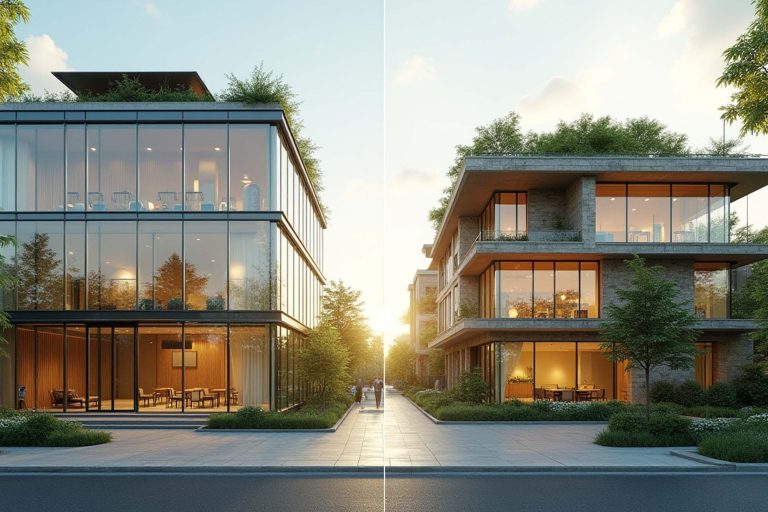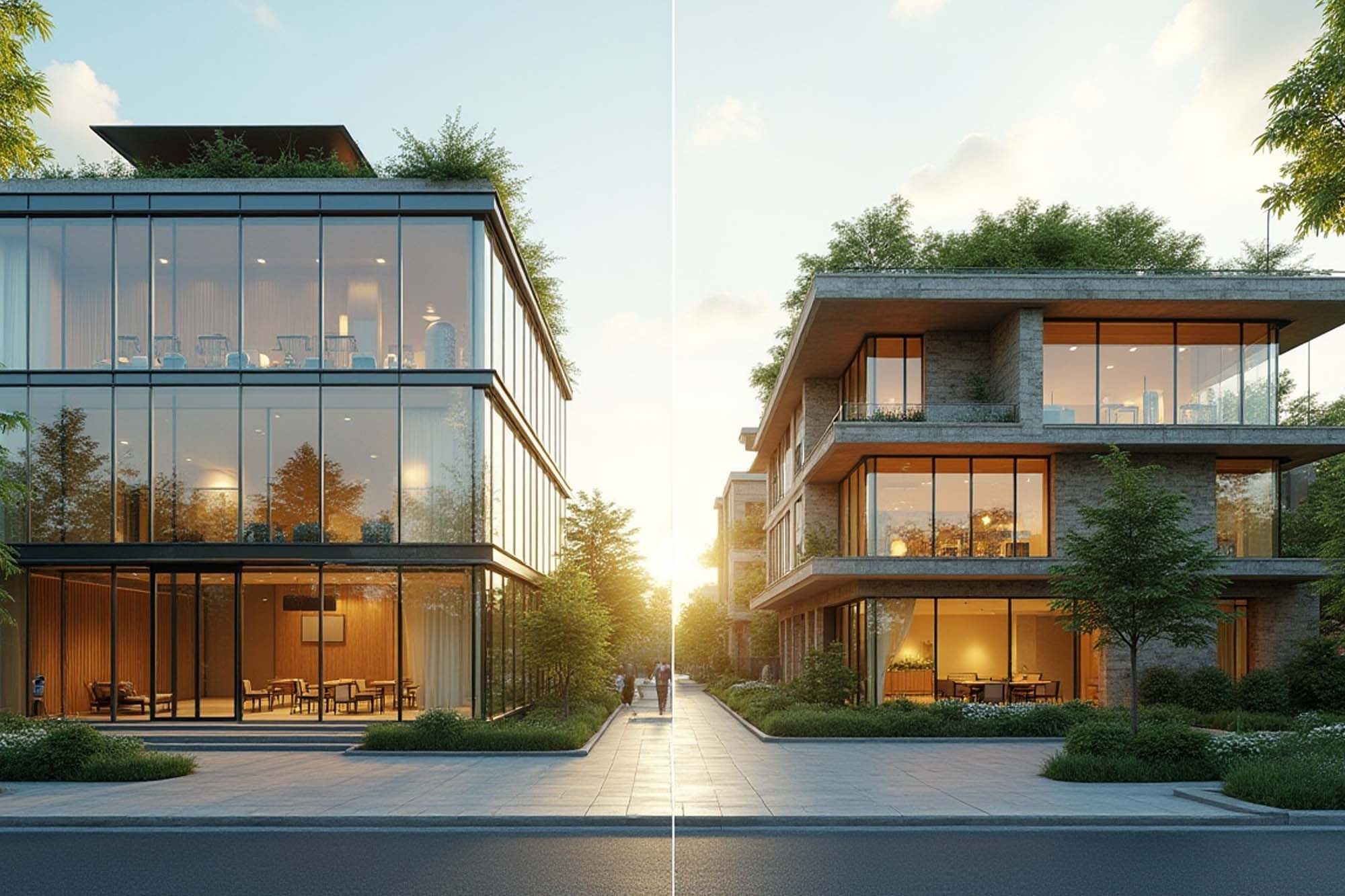
The terms green buildings and sustainable architecture are often used interchangeably in contemporary design discussions. While they share the common goal of reducing environmental impact, they represent different levels of thinking and responsibility within the built environment. Understanding this distinction is essential for architects, developers, and clients seeking to invest in truly responsible and future-ready spaces.
As the demand for environmentally friendly architecture continues to grow, it becomes increasingly important to recognize whether a project is simply improving performance metrics or embracing a deeper architectural philosophy rooted in long-term sustainability.
What Is a Green Building?
A green building primarily focuses on environmental performance and operational efficiency. It is designed to reduce its negative environmental impact through measurable strategies and technological systems. The emphasis is often placed on improving efficiency during the building’s operational phase.
Key characteristics of green buildings include:
- Energy-efficient mechanical systems
- Water-saving fixtures and rainwater harvesting
- Integration of renewable energy sources such as solar panels
- Waste reduction and recycling strategies
- Improved indoor air quality through better ventilation and low-VOC materials
In many cases, a conventional structure can become “green” by incorporating advanced technologies — high-performance insulation, efficient HVAC systems, and photovoltaic panels. In this sense, green buildings are often performance-driven and technology-focused. Their benefits are quantifiable and typically linked to reduced operational costs.
However, while green buildings improve efficiency, they may not always address broader contextual, social, or long-term adaptability concerns.
What Is Sustainable Architecture?
Sustainable architecture is broader, more integrated, and more strategic in its approach. It goes beyond operational efficiency and embeds environmental thinking into the core design concept from the very beginning.
True sustainable architecture buildings are shaped by climate responsiveness, site sensitivity, and long-term adaptability. Sustainable architecture considers:
- Site context and orientation
- Passive solar gain and shading strategies
- Natural ventilation and daylight optimization
- Lifecycle impact of materials
- Cultural relevance and local identity
- Social responsibility and community impact
- Long-term resilience and flexibility
Unlike green buildings, which may incorporate sustainable technologies into an existing framework, sustainable architecture integrates sustainability into spatial planning, structural systems, and material strategies from the conceptual stage.
For example, instead of relying entirely on mechanical cooling systems, a sustainably designed building may use passive shading, thermal mass, and cross-ventilation to regulate temperature. Instead of importing materials, it may prioritize locally sourced resources to reduce embodied energy.
In essence, sustainable architecture seeks harmony between people, place, and planet.
Key Differences
1. Scope of Responsibility
Green buildings focus on measurable environmental efficiency. The objective is to reduce resource consumption and improve performance metrics.
Sustainable architecture expands its responsibility to environmental, social, economic, and cultural dimensions. It evaluates not only how a building performs but also how it impacts communities and ecosystems over time.
2. Design Approach
Green design can sometimes be technology-driven, emphasizing upgraded systems and certifications.
Sustainable architecture is strategy-driven and integrated. It prioritizes passive design principles, contextual sensitivity, and lifecycle thinking before technological solutions are applied.
3. Long-Term Vision
Green buildings aim to reduce energy consumption and operational costs.
Sustainable architecture aspires to create resilient, adaptable environments that remain relevant and meaningful for generations. It forms the foundation for sustainable design for residential and commercial spaces, ensuring long-term environmental and social value.
Why This Distinction Matters
The difference between green buildings and sustainable architecture influences how we approach the future of the built environment. A building may achieve green certification and demonstrate excellent energy performance, yet still lack contextual sensitivity or adaptability.
True environmentally friendly architecture requires more than technological efficiency — it demands thoughtful planning, lifecycle awareness, and integrated design thinking.
The most impactful projects combine both approaches. They achieve measurable green performance while being rooted in a comprehensive sustainable architectural framework. By merging technical efficiency with holistic design strategies, architecture can move beyond minimizing harm and begin actively contributing to environmental regeneration and community well-being.
Conclusion
Understanding the difference between green buildings and sustainable architecture empowers clients and developers to make informed decisions. While green buildings improve operational efficiency, sustainable architecture integrates environmental responsibility into every design stage — from concept to long-term adaptability.
At Kham Design, sustainability is not treated as an add-on feature but as a foundational principle. Through thoughtfully planned sustainable architecture buildings and integrated sustainable design for residential and commercial spaces, Kham Design creates environments that are efficient, context-sensitive, and built to endure — shaping a more responsible architectural future.
If you are planning a sustainable residential or commercial project, connect with Kham Design to explore innovative, environmentally responsible design solutions tailored to your vision.